
Termoli and the coast
A walled old town on a headland, and thirty-five kilometres of beach around it.
Termoli is the only real seaside place in the region, and also the largest town after Campobasso. The old quarter stands on a headland, closed by walls, with the Swabian castle at the point and a maze of alleys inside; the Romanesque cathedral keeps the relics of Saints Basso and Timoteo. Outside the walls is the new town, and below it the beach.
The coast is thirty-five kilometres long and runs from the Trigno to the Saccione: it is the shortest among the Italian regions that have a sea at all, which is what keeps it quiet. The bottom is sandy almost everywhere, with a stretch of pebbles below the town, and it shelves gently. The campsites lie between Termoli and Campomarino, with the railway behind them and the motorway exit minutes away.
The trabucchi
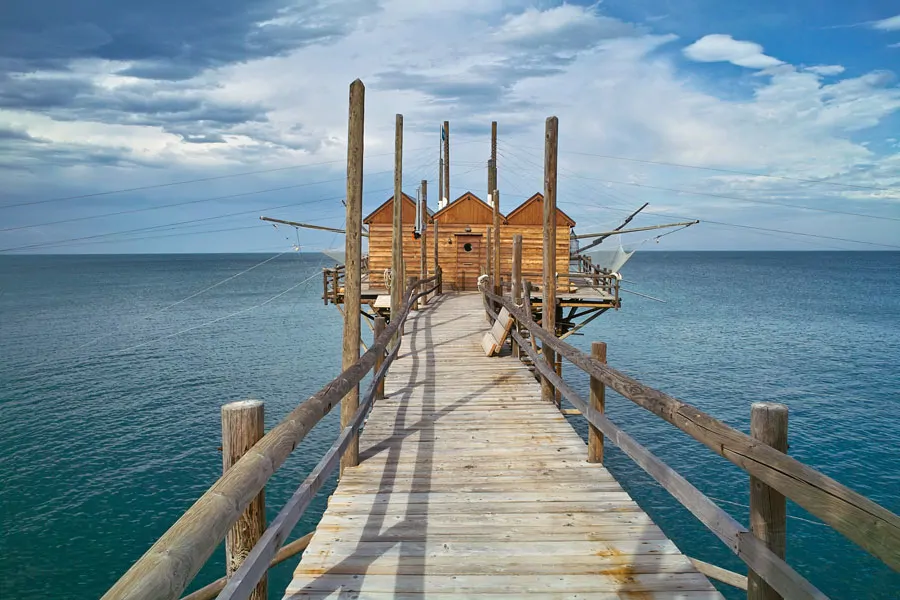
Along the coast to the north, towards the Trigno, a few trabucchi survive: wooden platforms driven into the rocks, with long arms that lower a square net. They were a way of fishing without going out in a boat when the sea was rough. Some have been restored and can be visited, others have become restaurants; the most photographed one stands just outside Termoli.
The rest of the coast is made of small places: Campomarino, which has the longest beach and vineyards behind it, Petacciato with its high viewpoint, Montenero di Bisaccia and Marina di Montenero towards the Trigno. There are no crowded promenades, and outside July and August many beach clubs stay shut.
Termoli is also where the boats for the Tremiti islands leave, and for many people that is the main reason to stop here. In summer the port is the one point in the region where you have to queue.